
The Chip War Nobody Asked For (But Everyone Needs)
Let’s be honest. Most people buying a flagship phone in 2025 aren’t sitting down with a spreadsheet comparing nanometer processes and they just want their phone to fly fast app launches,buttery smooth scrolling,epic gaming sessions and a battery that doesn’t tap out at 3 PM.
But here’s the thing: the chip inside your phone is the heartbeat of everything. It decides how fast your camera processes a night shot and how smoothly your Instagram Reels play, and whether your phone is still relevant two years from now.
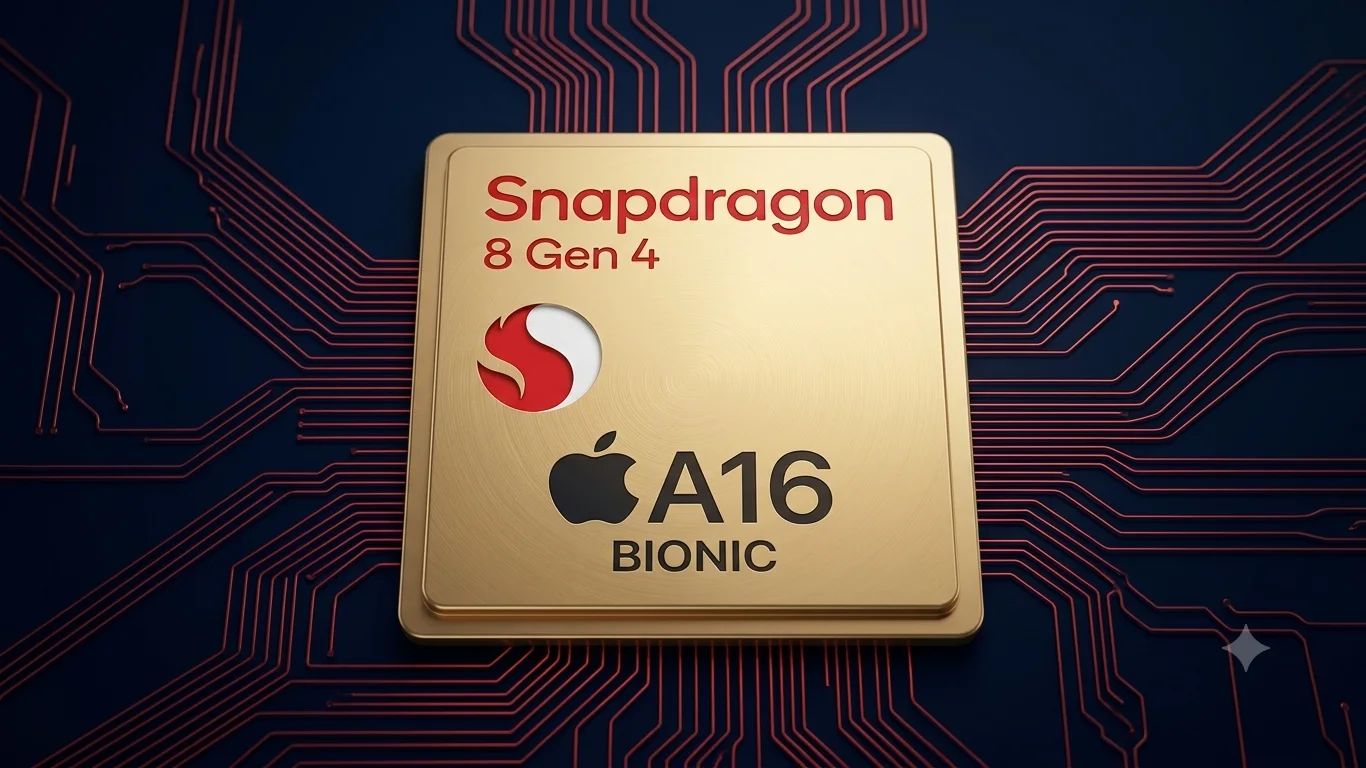
So when Apple’s A16 Bionic and Qualcomm’s Snapdragon 8 Gen 4 are thrown into the same ring, things get very interesting.
One is the brains behind the iPhone 14 Pro Apple’s most refined chip before the A17 era. The other is Qualcomm’s absolute beast of a processor, the chip powering Android’s elite lineup in late 2024 and into 2025. Two different philosophies. Two very different ecosystems. One question: which one wins?
A16 Bionic vs Snapdragon 8 Gen 4
Full specs, real benchmark numbers, gaming, battery, and a straight answer — no fluff.
 Apple · 2022
Apple A16 Bionic
Process: 4nm TSMC N4P
CPU: 6 cores (2 Performance + 4 Efficiency)
GPU: 5-core Apple GPU
Peak Clock: 3.46 GHz
Memory Bandwidth: 51 GB/s
Used in: iPhone 14 Pro, 14 Pro Max, iPhone 15
 Qualcomm · 2024
Snapdragon 8 Elite (Gen 4)
Process: 3nm TSMC N3E
CPU: 8 cores (2+6 Oryon 2 custom cores)
GPU: Adreno 830
Peak Clock: 4.32 GHz (SM8750-AC: 4.47 GHz)
Memory Bandwidth: 77 GB/s
Used in: Galaxy S25, OnePlus 13, Xiaomi 15
📋 What’s Covered
| Spec | 🍎 A16 Bionic | ⚡ Snapdragon 8 Elite (Gen 4) |
|---|---|---|
| Launch | September 2022 | October 2024 ✓ Newer |
| Process Node | 4nm (TSMC N4P) | 3nm (TSMC N3E) ✓ |
| CPU Architecture | Apple Avalanche + Blizzard | Qualcomm Oryon 2 (custom) ✓ |
| CPU Cores | 6-core (2P + 4E) | 8-core (2+6 Oryon) ✓ |
| Peak CPU Clock | 3.46 GHz | 4.32 – 4.47 GHz ✓ |
| GPU | Apple 5-core GPU | Adreno 830 ✓ |
| GPU Memory Bandwidth | 51 GB/s | 77 GB/s ✓ (+51%) |
| L2 Cache | 20 MB ✓ | Not disclosed |
| L3 Cache | 24 MB ✓ | Not disclosed |
| Neural Engine / NPU | 16-core Neural Engine | Hexagon NPU Gen 4 ✓ |
| 5G Modem | Qualcomm X65 (integrated) | Snapdragon X80 ✓ |
| Wi-Fi | Wi-Fi 6E | Wi-Fi 7 ✓ |
| Bluetooth | 5.3 | 5.4 ✓ |
| USB Standard | USB 3.0 (iPhone 14 Pro) | USB 3.2 Gen 2 ✓ |
| Transistor Count | ~16 billion ✓ | Not disclosed |
| ISP | Apple ISP (Photonic Engine) | Spectra ISP (18-bit) ✓ |
| Max Display Support | 4K@60Hz | 4K@120Hz ✓ |
| Benchmark | 🍎 A16 Bionic | ⚡ Snapdragon 8 Elite |
|---|---|---|
| GB6 Single-Core | ~2,900 | ~3,033 ✓ |
| GB6 Multi-Core | ~7,200 | ~9,271 ✓ |
| GB5 Single-Core | ~1,879 | ~2,100 ✓ |
| GB5 Multi-Core | ~5,450 | ~6,500 ✓ |
| Single-Core Advantage | — | +4–5% ✓ |
| Multi-Core Advantage | — | +28% ✓ |
| GPU Metric | 🍎 A16 Bionic | ⚡ Snapdragon 8 Elite |
|---|---|---|
| GPU Name | Apple A16 (5-core) | Qualcomm Adreno 830 ✓ |
| Memory Bandwidth | 51 GB/s | 77 GB/s ✓ |
| AnTuTu GPU Sub-Score | ~310,000 (iOS, Metal) | ~1,130,000 (Android, Vulkan) ✓ |
| 3DMark Wild Life Extreme | ~3,200 | ~6,300 ✓ |
| 3DMark Stress Stability | ~90% | ~83% (slight throttle) |
| Genshin Impact (60fps cap) | Stable 60fps (iOS optimised) ✓ | 60fps (varies by device cooling) |
| GPU API | Metal (iOS only) | Vulkan + OpenCL (wider dev support) ✓ |
| Ray Tracing Support | Partial | Full hardware Ray Tracing ✓ |
| AnTuTu Category | 🍎 A16 Bionic (iOS / Metal) | ⚡ Snapdragon 8 Elite (Android / Vulkan) |
|---|---|---|
| Total Score | ~890,000 – 950,000 | ~2,759,190 ✓ |
| CPU Sub-Score | ~250,000 | ~583,775 ✓ |
| GPU Sub-Score | ~310,000 (Metal) | ~1,130,000 (Vulkan) ✓ |
| Memory Sub-Score | ~180,000 | ~350,000 ✓ |
| Comparable? | ❌ NO — Different APIs. Not a valid comparison. | |
| Factor | 🍎 A16 Bionic | ⚡ Snapdragon 8 Elite |
|---|---|---|
| Process Node Efficiency | 4nm | 3nm ✓ (better efficiency ceiling) |
| CPU Power (max load) | ~5–6W | ~6–7W (slightly higher) |
| Surface Temp (after CPU stress) | ~31°C ✓ | ~33°C |
| Throttling Behaviour | Very stable, rare throttle ✓ | Slight throttle on sustained GPU load |
| Real-world Battery Life | Excellent (iOS power management) ✓ | Excellent (depends on device OEM) |
| Charging Speed | 30W (iPhone 14 Pro) | Varies: 65W–100W+ depending on device ✓ |
| AI / Camera Feature | 🍎 A16 Bionic | ⚡ Snapdragon 8 Elite |
|---|---|---|
| Dedicated NPU | 16-core Neural Engine | Hexagon Gen 4 NPU ✓ |
| On-Device LLM Support | Limited (Siri on-device) | Full on-device LLM (up to 10B params) ✓ |
| On-Device Stable Diffusion | Slow / not supported | Supported, fast ✓ |
| Camera ISP | Apple Photonic Engine | Spectra 18-bit ISP ✓ |
| Max Camera Resolution | 48MP | 200MP ✓ |
| 8K Video Recording | ❌ No | ✅ Yes ✓ |
| 4K Video | 4K@60fps ✓ | 4K@120fps ✓ |
| AI Photo Enhancement | Deep Apple ecosystem integration ✓ | Qualcomm AI Hub (broader dev APIs) |
| Connectivity | 🍎 A16 Bionic | ⚡ Snapdragon 8 Elite |
|---|---|---|
| 5G Modem | Qualcomm X65 | Snapdragon X80 ✓ (faster, lower power) |
| Max 5G Download | Up to 4.4 Gbps | Up to 10 Gbps ✓ |
| Wi-Fi Standard | Wi-Fi 6E | Wi-Fi 7 ✓ |
| Bluetooth | 5.3 | 5.4 ✓ |
| Satellite Connectivity | Yes (Emergency SOS via satellite) ✓ | Supported on some devices |
| USB | USB 3.0 | USB 3.2 Gen 2 ✓ |
| NFC | Yes ✓ | Yes ✓ |
🍎 Pick A16 Bionic (iPhone 14 Pro) if…
- You use Mac, iPad, Apple Watch — the ecosystem lock-in is real and useful
- You want guaranteed 5–6 years of iOS updates
- Privacy and end-to-end encryption on iMessage, FaceTime matter to you
- You want the smoothest sustained gaming performance (less throttle)
- You are upgrading from an older iPhone and want zero learning curve
- Apps like Procreate, Final Cut, or Apple Arcade titles are part of your daily life
⚡ Pick Snapdragon 8 Elite (Gen 4) if…
- You want the fastest raw CPU and GPU available on Android in 2024–25
- You are a heavy gamer who wants full ray tracing and 120fps support
- Fast charging (65W–120W) matters more than anything
- You want on-device AI features like Stable Diffusion or local LLMs
- You want Wi-Fi 7, USB 3.2, and the X80 5G modem
- You prefer Android’s open ecosystem and wider device choice
Overall: Snapdragon 8 Elite (Gen 4) wins on specs. A16 Bionic wins on experience.
Every measurable spec — process node, CPU clock, GPU bandwidth, AI, connectivity — goes to the Snapdragon 8 Elite. But the A16 Bionic paired with iOS delivers something benchmarks can’t fully capture: consistency, optimisation, and long-term software support. Pick the chip that fits your platform, not just the one with bigger numbers.
Is the Snapdragon 8 Gen 4 better than the Apple A16 Bionic?
Yes, in raw benchmark performance the Snapdragon 8 Elite (Gen 4) is faster — it scores around 28% higher in Geekbench 6 multi-core and has 51% more GPU memory bandwidth. However, the A16 Bionic delivers a smoother real-world experience within iOS thanks to deep hardware-software optimisation.
What phones have the Snapdragon 8 Gen 4?
Qualcomm officially rebranded Snapdragon 8 Gen 4 as the Snapdragon 8 Elite. It powers the Samsung Galaxy S25 series, OnePlus 13, Xiaomi 15, OPPO Find X8 Pro, iQOO 13, and Realme GT 7 Pro.
What phones use the Apple A16 Bionic?
The A16 Bionic is inside the iPhone 14 Pro, iPhone 14 Pro Max, and the standard iPhone 15. Apple used it for the 14 Pro lineup in 2022 and continued it in the base iPhone 15 in 2023.
Which is better for gaming — A16 Bionic or Snapdragon 8 Gen 4?
For raw GPU performance, the Snapdragon 8 Elite wins with its Adreno 830 GPU (77 GB/s bandwidth, full ray tracing, 120fps support). For consistent, throttle-free gaming on iOS titles, the A16 Bionic is extremely stable. If you play on Android, the Snapdragon is the clear choice.
Is the A16 Bionic still good in 2025?
Yes. The A16 Bionic handles every task, app, and game with ease in 2025. Devices running it still receive the latest iOS updates and the real-world performance gap between it and newer chips is small for everyday use.
Which has better battery life — A16 Bionic or Snapdragon 8 Elite?
Both chips are efficient. The Snapdragon 8 Elite’s 3nm node gives it a theoretical edge, but the A16 Bionic in the iPhone 14 Pro runs cooler under sustained load. Real-world battery life depends more on battery size and software optimisation than the chip itself.
Is Snapdragon 8 Gen 4 better than A16 for camera?
The Snapdragon 8 Elite’s Spectra ISP supports up to 200MP sensors and 8K video recording, while the A16 Bionic’s Photonic Engine tops out at 48MP and 4K@60fps. For hardware camera capability, the Snapdragon 8 Elite is ahead. For the overall camera experience, Apple’s software processing often delivers better photos in day-to-day situations.
How much faster is the Snapdragon 8 Gen 4 compared to A16 Bionic?
In Geekbench 6 single-core, the Snapdragon 8 Elite is about 4–5% faster. In multi-core, it leads by around 28%. In 3DMark GPU benchmarks, the Adreno 830 scores roughly double the A16’s GPU score in cross-platform tests.
Does the Snapdragon 8 Gen 4 overheat?
The Snapdragon 8 Elite runs at around 33°C surface temperature after intensive CPU tasks — which is very good. However, sustained GPU loads can cause some throttling (stability around 83% in 3DMark stress tests). Device cooling design plays a big role — phones with vapour chambers handle it much better.
Which chip is faster for video editing on a phone?
The Snapdragon 8 Elite is faster on paper (28% higher multi-core score), but Apple’s iPhones with A16 Bionic benefit from ProRes video recording and hardware-accelerated export through the Apple ecosystem. For Android video editing apps, the Snapdragon 8 Elite is the faster choice.
Conclusion! The Verdict That Actually Makes Sense
At the end of the day, comparing the A16 Bionic vs Snapdragon 8 Gen 4 isn’t just a chip fight it’s a philosophy fight.
Apple believes in deep integration long term support and a curated experience and Every feature on an A16-powered iPhone works because Apple designed the hardware, the software and the services all as one unit and That’s not a gimmick and That’s a genuinely different way of building technology.
Qualcomm believes in raw power/openness and relentless innovation and The Snapdragon 8 Gen 4 is proof that Android silicon has never been stronger and It benchmarks higher and supports newer standards and gives manufacturers the tools to build incredible and wildly different devices.
If you want the newest/fastest/most spec-loaded chip- Snapdragon 8 Gen 4 wins.
If you want the most reliable/consistent and long lived experience the A16 Bionic ecosystem is still elite.
Neither choice is wrong. Both will make your phone feel fast, capable, and future-ready. The real question isn’t “which chip is better?” It’s which philosophy fits your life?
Answer that and you’ve already made the right choice.
Found this helpful? Share it with the friend who’s been stuck on the Android vs iPhone debate for three months. You know who they are.